The Labor government came to office promising higher standards of integrity, transparency and accountability after almost a decade of Coalition government corruption. Four years later, those promises are becoming harder to reconcile with the way Labor is actually governing.A $560 million infrastructure program that directed roughly three-quarters of ...
The most effective political power isn’t obtained through governments, legislation or formal institutions. Sometimes it works through other means: vexatious litigation, lobbying, money and the ability of well-connected organisations to impose consequences on people who challenge powerful interests. The experiences of former SBS journalist Mary ...
Zionist groups aggressively deny suggestions that they exert excessive influence over politics, media and cultural institutions, yet when prominent people speak out against Israel or in support of Palestine, those same groups will cancel people, force them into long-winded litigations, damage their reputations and proceed to ruin them commercially. Not
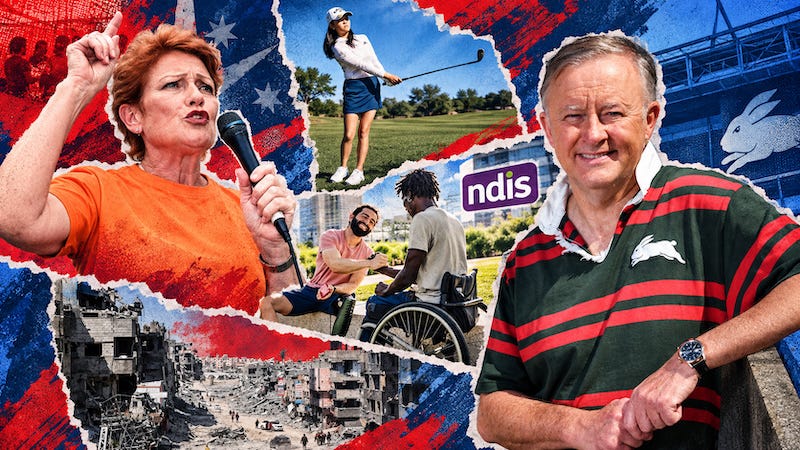
The Albanese government is coming across that uncomfortable rule of politics: a rort doesn’t become acceptable and respectable, just because it’s your side that’s doing it. The $560 million Major and Local Community Infrastructure program is becoming a serious integrity problem, with analysis showing around three-quarters of its funding flowing
Almost a year after Australia recognised Palestine as an independent and sovereign state, the Albanese government faces an increasingly difficult question: what did recognition actually change?Recognition was supposed to support Palestinian sovereignty, self-determination and the right of Palestinians to remain on their land. Yet Australia has imposed ...
One Nation may be slipping slightly in the opinion polls, but Pauline Hanson is still setting the direction of conservative politics in Australia. Instead of distinguishing the Liberal Party from the far right, opposition leader Angus Taylor appears determined to follow Hanson deeper into the culture wars – competing for
It’s coming up to a year since Australia recognised an independent and sovereign Palestine, ostensibly to “support the aspirations of the Palestinian people”, and “advance prospects for peace and stability in the region”. Of course, this was a momentous decision, and signalled a shift in diplomatic thinking but what, if
One Nation might be slipping in its opinion poll numbers – now that more people are looking at who they are and what they represent – but it’s still setting the agenda for conservative politics. Angus Taylor’s answer isn’t to differentiate the Liberal Party from Pauline Hanson, but to chase
The catastrophic Nepal–Tibet floods are not just another distant natural disaster. Triggered by the collapse of glacial ice and rock high in the Himalayas, the resulting torrent travelled through the valley below, destroying communities, roads, bridges and hydropower facilities. More than 1,250 people have been confirmed dead, over 4,200 remain
One Nation’s byelection win in Secret Harbour is a warning sign for the Albanese government, and the federal Labor Party would be wise to read it correctly. We look at why a minor party gained an 18 per cent swing in a seat WA Labor had held for 37 years,
The weekend saw something disturbing on the streets of Sydney, when 39 Israeli soldiers and military veterans – many of whom had been involved in the military campaigns in Gaza, West Bank and Lebanon – were granted visas to enter Australia and allowed to run in the Sydney Marathon.The Australian
The Sydney Marathon controversy – where around 40 Israel Defence Forces personnel from the infamous Golani Brigade and Unit 8200 participated – presents the Albanese government with that same old question it has repeatedly avoided for almost three years: when will condemnation of Israel actually produce some consequences?There were protests
The Labor government came to office promising higher standards of integrity, transparency and accountability after almost a decade of Coalition government corruption. Four years later, those promises are becoming harder to reconcile with the way Labor is actually governing.A $560 million infrastructure program that directed roughly three-quarters of ...
The most effective political power isn’t obtained through governments, legislation or formal institutions. Sometimes it works through other means: vexatious litigation, lobbying, money and the ability of well-connected organisations to impose consequences on people who challenge powerful interests. The experiences of former SBS journalist Mary ...
Zionist groups aggressively deny suggestions that they exert excessive influence over politics, media and cultural institutions, yet when prominent people speak out against Israel or in support of Palestine, those same groups will cancel people, force them into long-winded litigations, damage their reputations and proceed to ruin them commercially. Not
The Albanese government is coming across that uncomfortable rule of politics: a rort doesn’t become acceptable and respectable, just because it’s your side that’s doing it. The $560 million Major and Local Community Infrastructure program is becoming a serious integrity problem, with analysis showing around three-quarters of its funding flowing
Almost a year after Australia recognised Palestine as an independent and sovereign state, the Albanese government faces an increasingly difficult question: what did recognition actually change?Recognition was supposed to support Palestinian sovereignty, self-determination and the right of Palestinians to remain on their land. Yet Australia has imposed ...
One Nation may be slipping slightly in the opinion polls, but Pauline Hanson is still setting the direction of conservative politics in Australia. Instead of distinguishing the Liberal Party from the far right, opposition leader Angus Taylor appears determined to follow Hanson deeper into the culture wars – competing for
It’s coming up to a year since Australia recognised an independent and sovereign Palestine, ostensibly to “support the aspirations of the Palestinian people”, and “advance prospects for peace and stability in the region”. Of course, this was a momentous decision, and signalled a shift in diplomatic thinking but what, if
One Nation might be slipping in its opinion poll numbers – now that more people are looking at who they are and what they represent – but it’s still setting the agenda for conservative politics. Angus Taylor’s answer isn’t to differentiate the Liberal Party from Pauline Hanson, but to chase
The catastrophic Nepal–Tibet floods are not just another distant natural disaster. Triggered by the collapse of glacial ice and rock high in the Himalayas, the resulting torrent travelled through the valley below, destroying communities, roads, bridges and hydropower facilities. More than 1,250 people have been confirmed dead, over 4,200 remain
One Nation’s byelection win in Secret Harbour is a warning sign for the Albanese government, and the federal Labor Party would be wise to read it correctly. We look at why a minor party gained an 18 per cent swing in a seat WA Labor had held for 37 years,
The weekend saw something disturbing on the streets of Sydney, when 39 Israeli soldiers and military veterans – many of whom had been involved in the military campaigns in Gaza, West Bank and Lebanon – were granted visas to enter Australia and allowed to run in the Sydney Marathon.The Australian
The Sydney Marathon controversy – where around 40 Israel Defence Forces personnel from the infamous Golani Brigade and Unit 8200 participated – presents the Albanese government with that same old question it has repeatedly avoided for almost three years: when will condemnation of Israel actually produce some consequences?There were protests